Executive Summary
- Ukraine’s leadership has proclaimed the country ready for rapid accession to the European Union (EU) after it received candidate status in June 2022. The EU is widely expected to open negotiations with Kyiv in December 2023, but for most EU capitals, Ukraine’s accession remains a long-term vision.
- Ukraine will have considerable work to do to meet EU conditionality. These adjustments will in time shape the ultimately political accession process.
- Large member states, including Germany, France, and Poland, will play crucial roles in this process. They can help ensure that Ukraine’s European perspective does not bog down in bureaucracy and procrastination.
- In Germany, centrist leaders will need to maintain and expand the consensus in support of Ukrainian accession and overcome fears of the political, economic, and social stress that enlargement will place on the cohesion of the EU.
- In France, it will be crucial to maintain the current momentum toward bolstering the EU as a bulwark against Russian aggression and to emphasize the role that Ukraine can play in strengthening Europe as a political project.
- In Poland, Warsaw’s leadership of the transatlantic pro-Ukraine coalition will need to be defended against Eurosceptic forces that threaten to undermine the country’s relationship with Germany, France, and the European Commission, as well as corrode European solidarity as a whole.
- Across the three capitals, it will be imperative to tackle key structural challenges head-on, including reform of the EU’s Common Agricultural Policy and other funding programs, qualified majority voting, and the broader distribution of power. The imperative of solidarity with Ukraine can overcome local political recalcitrance.
-
Introduction
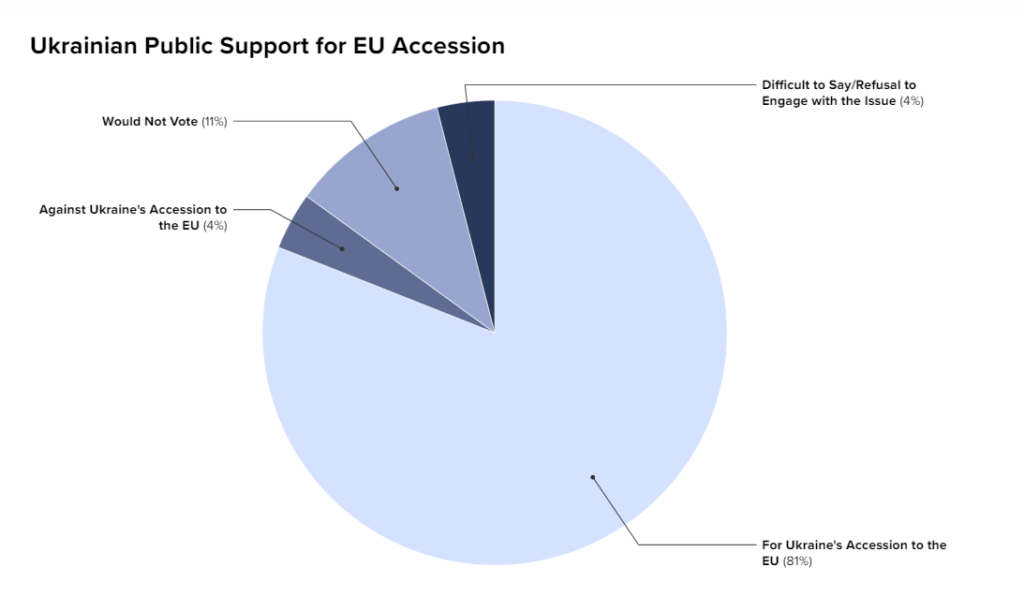
Ukrainian society is united in its choice to join the European Union. In August of 2023, over 80% of Ukrainians were in favor of membership.1 Ukrainian leaders have repeatedly expressed the ambition to accede to the EU within two years regardless of whether the country has won the war against Russia. Europe, too, is virtually unanimous in its support for Ukraine’s European future. However, all parties must remain wary of underestimating the height of the hurdles they must clear.
In October 2023, the European Commission is expected to produce an assessment of Ukraine’s performance on the preconditions for accession, with a decision to be made by December about whether to open negotiations. Most discussions of Ukraine’s path to EU accession center on the challenges of reform and diplomacy facing Kyiv. Ukraine must focus on transforming institutions to suit the demands of the common market, adopting or approximating acquis communautaire, and opening and closing negotiating chapters, each of which can be blocked by any member state.
No less daunting, however, are the challenges the EU faces if it admits Ukraine. Doing so will pose an unprecedented test of Europe’s political, social, and economic cohesion. With a population of more than 40 million, Ukraine would become the EU’s fifth-largest member state, behind Spain and ahead of Poland. It would also be the EU’s poorest member state by far, with pre-war gross domestic product (GDP) per capita of less than half of that of Bulgaria. Without reform, adding Ukraine to the bloc would turn current beneficiaries of EU funding into net contributors.
Accommodating Ukraine will thus require large-scale reforms to the Common Agricultural Policy, distribution of structural and cohesion funds, allocation of seats in the European Parliament, portfolios in the European Commission, qualified majority voting practices, and the current necessity of unanimity on foreign policy. These reforms may be long overdue, but the fact that they remain unresolved only underscores their political, economic, and social complexity.
The legal requirements for EU accession have always depended on adherence to the fundamental political, legal, and market principles of the EU, and rightly so. Achieving compliance with these conditions takes time for a country that has had vastly different legal, political, and economic structures. However, the lack of a clear timeline is more likely due to the absence of political consensus on the desirability and feasibility of swift accession for Ukraine among EU member states. Any member state can block the opening of accession negotiations or the negotiations themselves if no compromise is reached on the benchmarks embedded in negotiation chapters.2 However, the political nature of decision-making on EU enlargement is a double-edged sword. While allowing member states to project their national interests on the accession process, it may also undermine the candidate’s trust in the merit-based nature of accession mechanisms. For example, membership negotiations with Turkey have been stalled since 2005. The accompanying decline in trust between Ankara and Brussels exemplifies the dynamic described. Another example is the growing dysfunction in EU relations with candidate countries in the Western Balkans.
Ensuring that the necessity of reform does not become an obstacle to the imperative of membership for Ukraine will require political will on the part of EU members. The positions of large member states such as France, Germany, and Poland will prove crucial both in shepherding Ukraine into the EU and in shaping the EU that emerges as a result. With that in mind, this paper analyzes the opinions and perspectives in Paris, Berlin, and Warsaw on Ukraine’s EU accession, identifying the pivotal points that will need to be addressed by politicians and opinion leaders in the three capitals and across the EU